


Clean Chaeto Infused with Live Copepods & Amphipods
Clean Chaeto Infused with Live Copepods & Amphipods
Couldn't load pickup availability
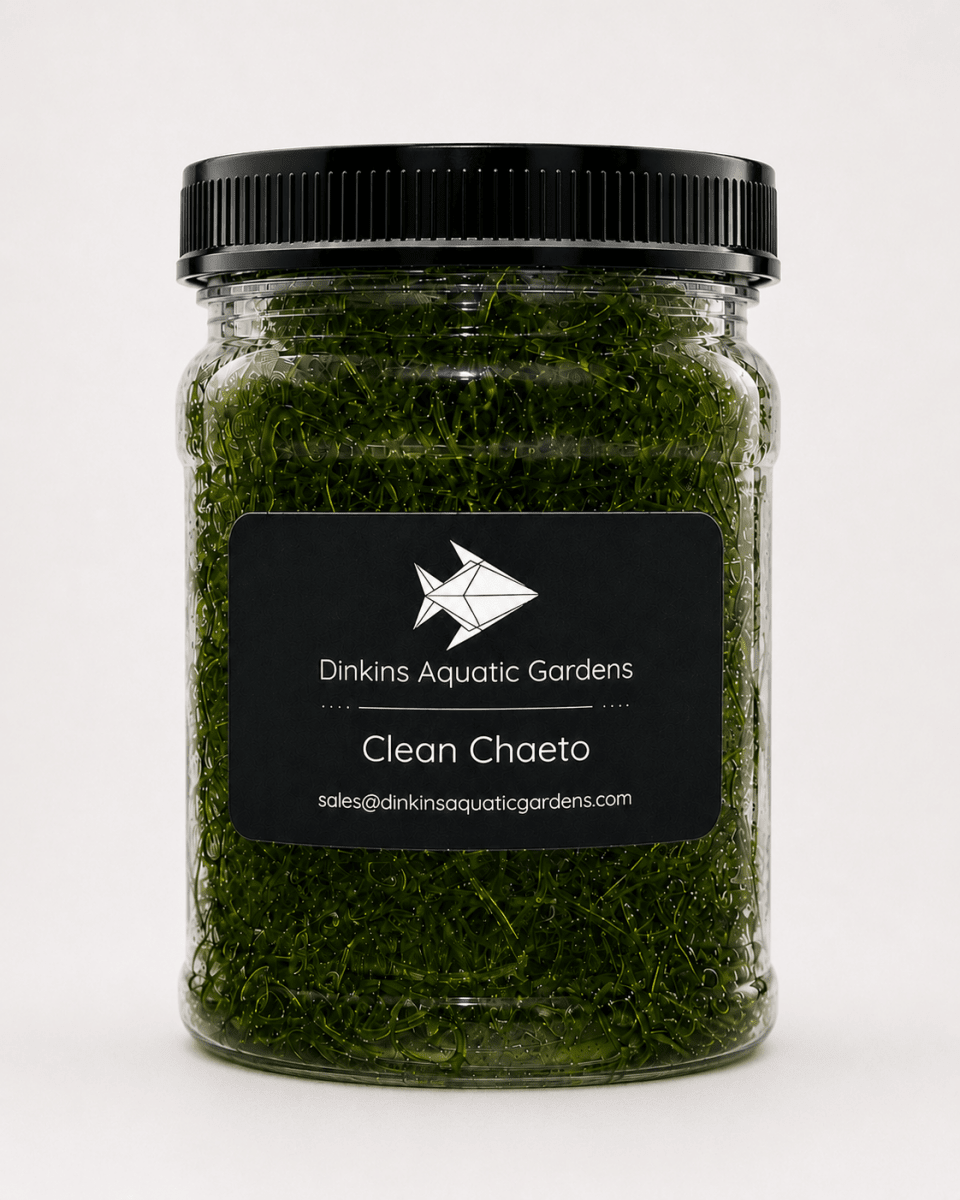
Each "softball sized" portion of chaeto weighs about 1/4 pound and is packaged in a jar containing about 8 ounces of our Reef Snacklebox live copepod blend. Each jar only contains about one inch of water. Chaeto travels best when damp rather than submerged.
Chaetomorpha is a green, spaghetti-like macroalgae intended both for nutrient export and as a host for beneficial copepods and amphipods. Chaeto is great for removing nitrates and phosphates from your water naturally. Pods of all types also love to make their home in the fine, tangled strands.
Unlike most sellers who ship their chaeto merely damp in bags, we ship ours in rigid plastic jars. Each jar is filled with a generous portion of our Reef Snacklebox three species copepod blend. This keeps your chaeto wet and healthy during transport and provides a significant boost to your refugium's biodiversity.
Our chaeto is kept in fishless systems to keep it pest-free. These isolated systems contain only chaeto, fresh saltwater, copepods and amphipods. This minimizes the risk of any unwelcome hitchhikers and the beneficial pods help jump-start your refugium.
Can't Grow Chaeto? You Had the Wrong Strain
There are over 70 different species of Chaetomorpha macroalgae, and they all grow differently. The late Jake Adams of Reefbuilders refers to the two primary species available in the hobby as "brillo" and "fine."*
Most people are familiar with the more difficult-to-grow "brillo" variety which forms extremely curly strands that tend to grow more densely interwoven with time. It grows more slowly and is quite a bit more finicky and particular of its growing conditions. When we tried growing this variety - the one that many vendors sell - we didn't have much luck either. If you've tried to grow chaeto and failed, there's a good chance that you had the "brillo" variety. It works well, but you have to hit its needs very specifically for it to thrive.
We sell the much more forgiving and more rapidly-growing "fine" variety. It tends to produce longer strands that are less curly and creates a mass that is less dense, so water flows through it better and prevents it from becoming a detritus trap. Our "fine" variety is also much more forgiving of light PAR, flow rates, and the like. If you haven't been able to grow chaeto in the past, give us a try. I think you'll be pleasantly surprised!
Simply put the chaeto in an area of your sump with moderate flow and light it as brightly as possible - you can use simple shop lights from the hardware store or can go high tech with specially-designed refugium lighting. As the chaeto grows, it's helpful to dose it with additional trace elements like Brightwell Aquatics' ChaetoGro. Once your chaeto starts to overgrow your refugium, you'll want to remove and discard about half to make room for future growth.
*Reference https://reefbuilders.com/2021/03/23/chaetomorpha-strains-are-much-more-different-than-we-thought/
Buy With Confidence
Shopping for live goods online can be stressful, but we use best-in-industry shipping practices such as biodegradable styrofoam boxes, checking your weather and including heat/ice packs as needed, and sending all orders with UPS two day shipping. If anything goes wrong, we have your back with our completely hassle-free, no-questions-asked Dinkins Delivery Guarantee.
Don't take our word for it - check out our reviews section to see what other reefers are saying!
Frequently Asked Questions
Can you guys really ship safely in the hot summer?
Absolutely! We Ship for Survival year-round, using UPS two day shipping, styrofoam boxes, and an iron-clad live delivery guarantee. We also offer the option to pick your own delivery date.
Why should I buy Clean Chaeto from Dinkins Aquatic Gardens?
There are many excellent suppliers of chaetomorpha on the market. The main thing that sets us apart from the crowd is our focus on quality and customer service.
In terms of quality, we offer totally pest-free, aquacultured Clean Chaeto. It isn't harvested from the ocean, nor is it grown in systems with fish and inverts. Our Clean Chaeto is grown in completely isolated systems.
We also sell a different strain of chaetomorpha than most other vendors. Our "fine" spaghetti-like chaeto grows much faster and is vastly more forgiving than most other variants.
We also pride ourselves on our award-winning customer service: the Dinkins Difference. Every order of Clean Chaeto is fully backed by the Dinkins Delivery Guarantee.
How much Clean Chaeto should I buy?
We suggest buying one jar of Clean Chaeto (approx. 1/4 pound) for every 60 gallons of tank volume.
Double that to two jars per 60 gallons for high nutrient tanks (such as predator tanks or some FOWLR tanks).
Halve that amount of lower nutrient tanks or tanks with smaller refugiums.
How do I add Clean Chaeto to my tank/refugium?
Our Clean Chaeto loves strong indirect flow and strong light. Ideally you'll add the chaeto to your sump, either before or after your skimmer, and direct the flow in such a way that it doesn't blow directly on the chaeto. The chaeto should be well-lit - specialty refugium lights are ideal, but a powerful full spectrum shop light will normally work fine.
We do strongly recommend supplementing your chaeto with trace elements and iron - Brightwell's ChaetoGro is a fantastic product for this purpose. You definitely can add chaeto directly to your display tank if you don't mind the aesthetic. AIO tanks can normally host chaeto as well, just find room in the filtration chamber assuming you can find a good placement for your light.
Does Clean Chaeto have to tumble?
No. Tumbling is ideal but not required. Clean Chaeto likes strong, indirect flow; if you cannot get it to tumble, simply flip it over every week by hand.
I just can't seem to grow chaeto. What makes yours so different?
Our Clean Chaeto is the less-commonly found "fine" spaghetti-like variant. It's significantly more forgiving and faster growing than the more common "brillo" kind that most vendors sell.
We completely understand - we struggled for four months to try to grow the more common "brillo" variety and failed miserably. It was only after we started working with this "fine" variant that we achieved success.
I have tried so many vendors and dealt with everything from a proven aiptasia contamination to the chaeto just disintegrating. I even have an XR15 on my refugium right now due to a tank transition. This chaeto is the absolute best I’ve found. Not only is it healthy and growing, it’s loaded with pods!! What more could you ask for!? Don’t even think twice. Get this stuff.

No issues. Very happy with order!
Dinkins always excellent!
The bottle was packed with Chaeto and pods just as the picture showed. The Chaeto was a nice green color and thriving. Will buy more soon.
Just as described
Great customer service, awesome packaging and quick delivery. I’ll definitely be buying from them again!
Arrived fast with a nice personal thankyou. Great business so far and I will use again.
Only had about a 1/4 full of liquid, chaeto was clean.
Received my chaeto very quickly and it has been growing great! Excellent product and service from Dinkins. Highly recommend!
I received my chaeto a couple of days ago and I have been very pleased with it. I have had chaeto in the past and it falls apart easily and gets all over the tank. Dinkin's chaeto stays together and I have not had a problem with it getting all over the tank or my sump.. The extra pods were a great bonus! The only problem I see is that I should have purchased more than I did, but that can be easily corrected....I am sure they have more!
Dinkins has once again brought a great product to those of us who reef.
After getting a promotional email about Dinkins new clean chaeto I jumped on the chance as I was setting up a refugium in my sump. The chaeto came healthy and full of pods. It has only been 1 day so I'll come back after a month or two and let you know how it grows out. I'd say at first look this is the cleanest chaeto I've come across and it was dense too. Not some floppy strands, a nice solid ball of clean chaeto. Dont forget to add pods to your order!
I got the email from Dinkins that they were now offering chaeto and jumped on ordering. I was very pleased with my initial purchase. It arrived very fresh, smelled very oceans and was a deep, beautiful green color. Shipping was very fast, I ordered this with pods and phyto, everything came together safely packaged. Very impressed and definitely will purchase again. Unfortunately, I put it in my refugium right away, and now can't get a decent photo. But trust me, you'll be very happy with this purchase!